Who it suits
Who are the donors in our egg bank
Our egg bank in Georgia includes only women aged 18 to 33 with confirmed health. We do not recruit donors as a separate service and do not work through intermediaries: every donor is examined at our clinic, according to the requirements of the Georgian Ministry of Health, and only then does her profile enter the donor database.
Requirements for a donor:
- age 18–33;
- normal physical and mental health, without chronic diseases;
- no genetic or hereditary defects in the family;
- normal body weight and a pleasant appearance;
- preference for women with at least one healthy child;
- willingness to undergo all the medical and psychological tests.
The tests every donor undergoes at our clinic include blood tests for infectious diseases, a hormonal profile and assessment of the ovarian reserve, a gynecological ultrasound and genetic screening. We know our donors: we know how many good-quality eggs they produce per cycle and which of their previous donations resulted in a pregnancy.
Donor programmes
How to choose an egg donor at our clinic: profile, matching and photos
In an anonymous donation you do not know who the donor is, but you see her profile: hair and eye color, facial features and build, blood group, number of children and the results of the medical and genetic tests. Most of our patients choose a donor with an appearance similar to their own and a compatible blood group, and our fertility doctor recommends the best match from the medical point of view. To make the right choice, we give every couple time and full medical information about every donor who suits them.
What about a donor database with photos? The extent of the visual information in the profile is shown at the consultation, in accordance with the rules of anonymity; identifying details of the donor are not disclosed, and the donor receives no information about the patient either.
A non-anonymous donation is also possible: a relative or acquaintance who agrees to donate undergoes exactly the same tests at our clinic, and only after medical approval do we start the program.
The selection process in three steps:
-
Consultation and tests of both partners
We check the woman’s endometrium and hormonal profile and the man’s semen analysis; part of the tests can be done in your home country.
-
Choosing the donor from the database
You define what matters to you, and we present suitable profiles with a medical recommendation.
-
Coordinating the cycle
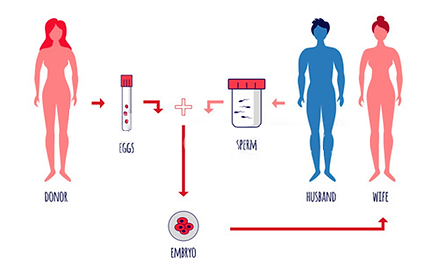
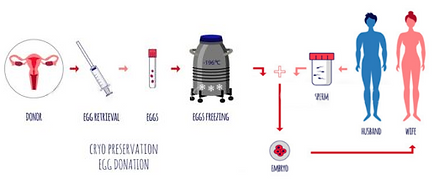
We synchronize the donor with the patient (fresh eggs) or set a date for thawing (frozen eggs).
Prices
Egg donation programs and prices
Every program includes one embryo transfer; each additional transfer — €1,500. Genetic testing of the embryos (PGD with NGS) — €500, the NIPT test is included. Prices may vary by up to 10% depending on the case. Surrogacy with donor eggs costs €59,000 at our clinic, and the guaranteed program until the birth of the child — €65,000.