6010, Georgia, Batumi, Rustaveli Ave, 39
M-F 10-17 | Sat 10-14 | Sun: OFF

Testicular Biopsy

conclusion image

Today, male infertility accounts for 40-50 % of all causes of infertility in married couples. Male infertility is a violation of the male reproductive function, which leads to the inability to conceive a child. Most often, signs of male infertility are a qualitative and quantitative decrease in spermogram indicators or a violation of the mechanisms of sperm delivery.If a couple does not get pregnant regularly during one year of sexual life, this is an occasion to consult a doctor such as a reproductologist. A fertility specialist works with the female form of infertility, in conjunction with a urologist and an andrologist who specializes in male factor infertility.

Causes of male infertility

Infectious and inflammatory diseases of the genitourinary system. Sexually transmitted diseases(trichomoniasis, chlamydia, gonorrhea, syphilis, brucellosis, mumps, tuberculosis, etc.) can most likely harm the reproductive function. Similarly, inflammatory diseases of the prostate and ureters often lead to infertility.

Varicocele. The expansion of vessels in the testicles and spermatic cord leads to an increase in the temperature in the scrotum(above 34°C ) and negatively affects the development of spermatozoa. This condition leads to damage and death of the seed.

Hormonal disorders. Failure in the hormonal background causes the death of spermatozoa and prevents the development of new ones.

Congenital abnormalities of the development of the genitals( non-omission or torsion of the testicles).

Sexual violations. Erectile dysfunction( weak or no erection), premature ejaculation.

Oncological diseases.

Surgery. Some operations may prevent the mechanical entry of sperm into the ejaculate. These are vasectomies, operations for inguinal hernia, operations on the scrotum or testicles, operations on the prostate and large operations on the abdominal cavity.

External factors. Overheating or overcooling of the testicles, pesticides, radiation, heavy metals, etc.

Bad habits and lifestyle also negatively affect male fertility. Smoking tobacco, taking drugs, alcohol abuse, obesity. When planning a pregnancy, it is advisable to give up bad habits for at least 3 months, so that the sperm has time to update and be more healthy.
How to detect male infertility?

Diagnostics

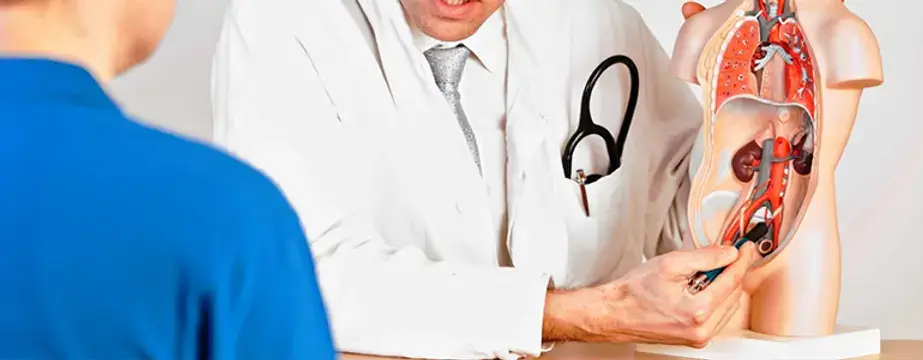
  1. Consultation of a urologist-andrologist, examination and collection of anamnesis. The doctor inspects male, palpation will help to identify conditions such as varicocele, cryptorchism anomalies development of genital organs. The survey allows you to identify hereditary diseases, chronic diseases, lifestyle, and features of sexual life.

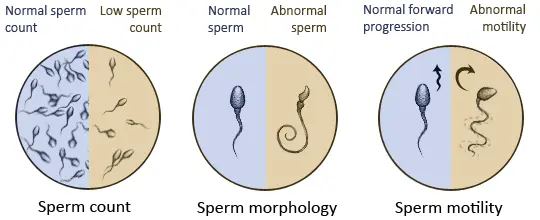
  2. The semen analysis. An integral and mandatory part in the diagnosis of male infertility. Using sperm analysis, doctor can determine the number of sperm ejaculate, their concentration, motility, morphological characteristics, normal and pathological forms, and so on.

How to prepare for the sperm analyse and what the results may be

  • It is important to finish taking medications, especially antibiotics, 2 weeks before sperm collection.

  • Sexual abstinence of 3-5 days.

* For 4-5 days, exclude alcohol intake, thermal procedures (baths, saunas).

* Sperm is given by masturbation in the laboratory, collected in a sterile container. It is allowed to collect sperm at home under all hygienic conditions, its collection in a sterile container and transportation must be carried out within 1 hour at a temperature of 37 degrees( most often the container is placed under the armpit).

* It is forbidden to use a condom, because it contains various lubricants that can negatively affect the sperm.

What are the results of a spermogram?

conclusion image

The following terms are used depending on the results of the study:

​– normospermia ( all sperm counts are within the normal range).

– asthenozoospermia (reduced sperm motility)

– teratozoospermia(high number of spermatozoa with pathological forms or functioning).

– oligozoospermia ( the number of spermatozoa is below normal).

-oligoasthenoteratozoospermia – a profound violation of spermatogenesis, which disrupted all of the indicators(number, morphology, motility).

-necrozoospermia ( dead sperm).

– azoospermia(absence of spermatozoa).

If you received a spermogram with reduced indicators, there is no reason for frustration and panic, the final conclusion and diagnosis is made after 2-3 times of sperm analysis, because many factors affect the analysis indicators, such as food consumed, medication, stressful situations, physical labor, and much more. Indicators of re-donated sperm may be completely different.

​If deviations are detected, further tactics are determined individually and may disable the following research methods:​

​* Ultrasound examination of the scrotum.

* Smears from the urethra

* Infection tests (sexually transmitted infections).

* Determining the level of hormones in the blood

* Testicular biopsy.

Treatment of male infertilityThe treatment strategy depends on the cause of infertility.It can be medication or surgery.Medical treatment can last 1-3 monthsSurgical treatment is aimed at eliminating varicocele or restoring the passage of the ejaculate tract.

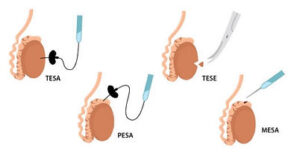
This method is a surgical extraction of sperm from the testicle and appendage. biopsy is primarily used in obstructive and non-obstructive azoospermia to obtain sperm for subsequent use in IVF/ICSI procedures.

Types of biopsy: TESA

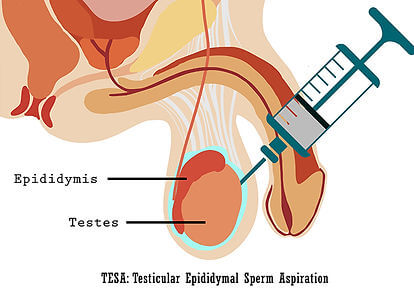
A thin needle is inserted through the skin into the testicular tissue and a vacuum is used to perform aspiration (suction) of the testicular tissue, from which spermatozoa are subsequently extracted. The advantage of this method is that it is not very traumatic for the patient. The disadvantage is the low probability of detecting spermatozoa in non-obstructive azoospermia (25-30%), which makes this method justified only in proven obstructive azoospermia, when the probability of spermatozoa is close to 100%. That is, when the seminal tubules are closed mechanically and the ejaculate cannot be released naturally.

Types of biopsy: TESA

Open testicular biopsy (TESE)

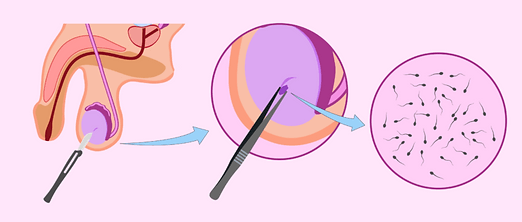
A small(up to 2 cm) incision of the skin of the scrotum is made, the testicle is allocated, its shell is dissected. From the resulting hole, a small piece of tissue is taken, which is examined for the presence of spermatozoa in it. The technique is quite traumatic, but with azospermia, the probability of detecting spermatozoa reaches about 40%.

Open testicular biopsy (TESE)